
There are two kinds of technology announcements. Some arrive like fireworks, bright enough to briefly rewrite the night. Others come more like good architecture, quiet, load bearing, and suddenly you cannot remember how you ever lived without the extra door, the better light, the stair that finally meets your foot where you expect it.
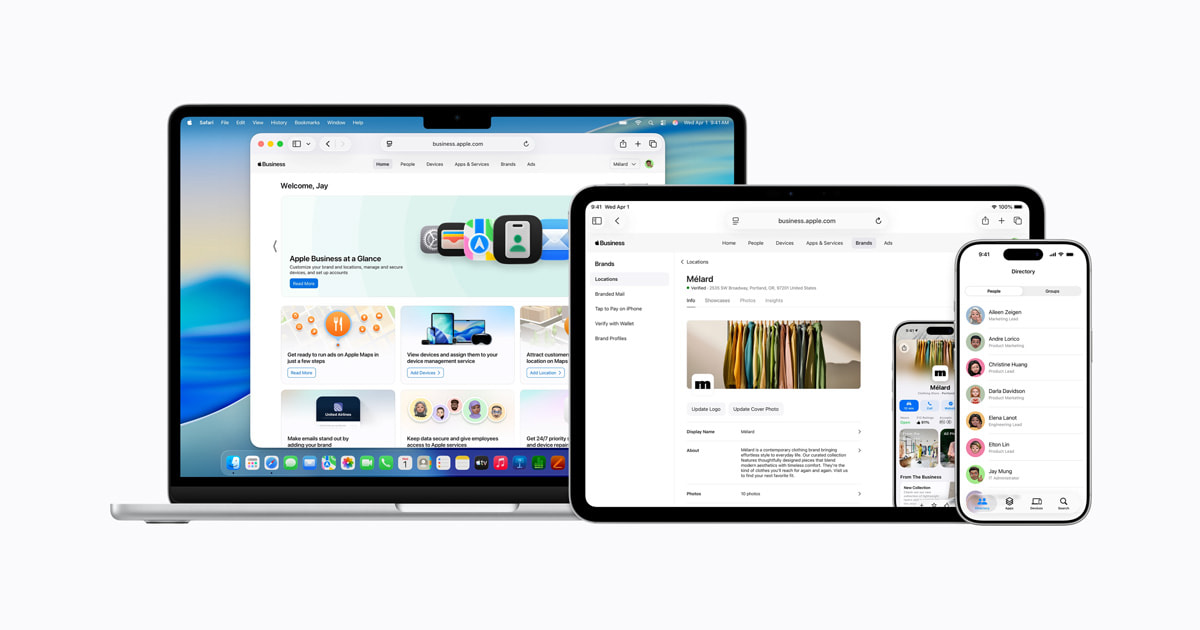
Apple’s latest news belongs to the second category. On March 24, 2026, Apple introduced Apple Business, a new all in one platform designed for businesses of all sizes, and it reads less like a gadget launch than a small reformation of daily work. Apple Business is scheduled to be available on April 14, in more than 200 countries and regions. The promise is not glamour, it is coherence.
At its core, Apple Business brings mobile device management into the house, built in rather than bolted on. For any organization that has ever tried to keep a handful of iPhones, iPads, or Macs aligned, the pain is familiar. Devices multiply; settings drift; security becomes a patchwork of best intentions. Apple’s answer is a unified console that lets administrators manage devices, configurations, and apps from one place, with a concept Apple calls Blueprints. In plain terms, a Blueprint is a repeatable setup, a template that can put the right settings and the right apps onto the right device, reliably. The detail matters because reliability is the difference between technology that empowers and technology that merely interrupts.
This is also where Apple’s long standing philosophy, control the experience end to end, becomes less about aesthetic purity and more about operational mercy. Apple Business supports zero touch deployment, meaning devices can be prepared to arrive ready for work, instead of arriving as blank slates that demand an afternoon of manual fussing. For small businesses without dedicated IT staff, that shift is not incremental. It is time returned.
Apple is also folding communication into the same sanctuary. Apple Business includes integrated email, calendar, and directory services with custom domain support, inviting a business to speak with a single, professional voice. The mechanics may sound ordinary, yet the implication is subtle. A shared directory and delegated calendars are, at their best, tools that reduce social friction. They remove the quiet embarrassment of, “Who do I ask,” and replace it with a system that simply knows, the way a well run library knows where to find the book you need.
Then comes the more provocative element, and the one most likely to test Apple’s reputation for restraint. Apple Business will, beginning this summer in the U.S. and Canada, enable businesses to create local ads in Apple Maps during search and discovery moments. The company emphasizes that ads will be clearly marked, and that Maps advertising is designed with privacy protections such that a user’s location and ad interactions are not associated with a user’s Apple Account. Apple is, in effect, trying to thread a needle: offering businesses a new way to be found, while insisting the compass still points toward privacy.
It is worth pausing on what that means culturally. Maps is not just an app, it is a layer of reality. When the map becomes a marketplace, the stakes change. Done well, it can help a neighborhood bakery surface above the noise, like a footnote elevated to a headline at the exact moment you are hungry. Done poorly, it becomes a kind of visual clutter, a city with too many billboards. Apple appears to understand the tension, and it is staking its argument on transparency and on device centered privacy, a familiar Apple refrain, but one that will need to be proven in the lived experience of use.
In the background, Apple is consolidating what used to be several separate offerings. Apple Business Connect, Apple Business Essentials, and Apple Business Manager are being brought under one roof, with existing data migrating at launch. This is the sort of consolidation that rarely inspires poetry, and yet it is exactly the kind of housekeeping that makes systems humane. When tools fragment, attention fragments with them. When tools unify, a team can return its attention to the work itself, the craft, the service, the conversation with customers that no interface can fully automate.
Perhaps that is the most “Church of Apple” reading of the moment: not that Apple has created something flashy, but that it is trying to make the ordinary feel less like administration and more like intention. In literature, the best sentences are often the ones that disappear, carrying you forward without showing their joints. Apple Business, at least in its ambition, wants to be that kind of sentence for modern work.