
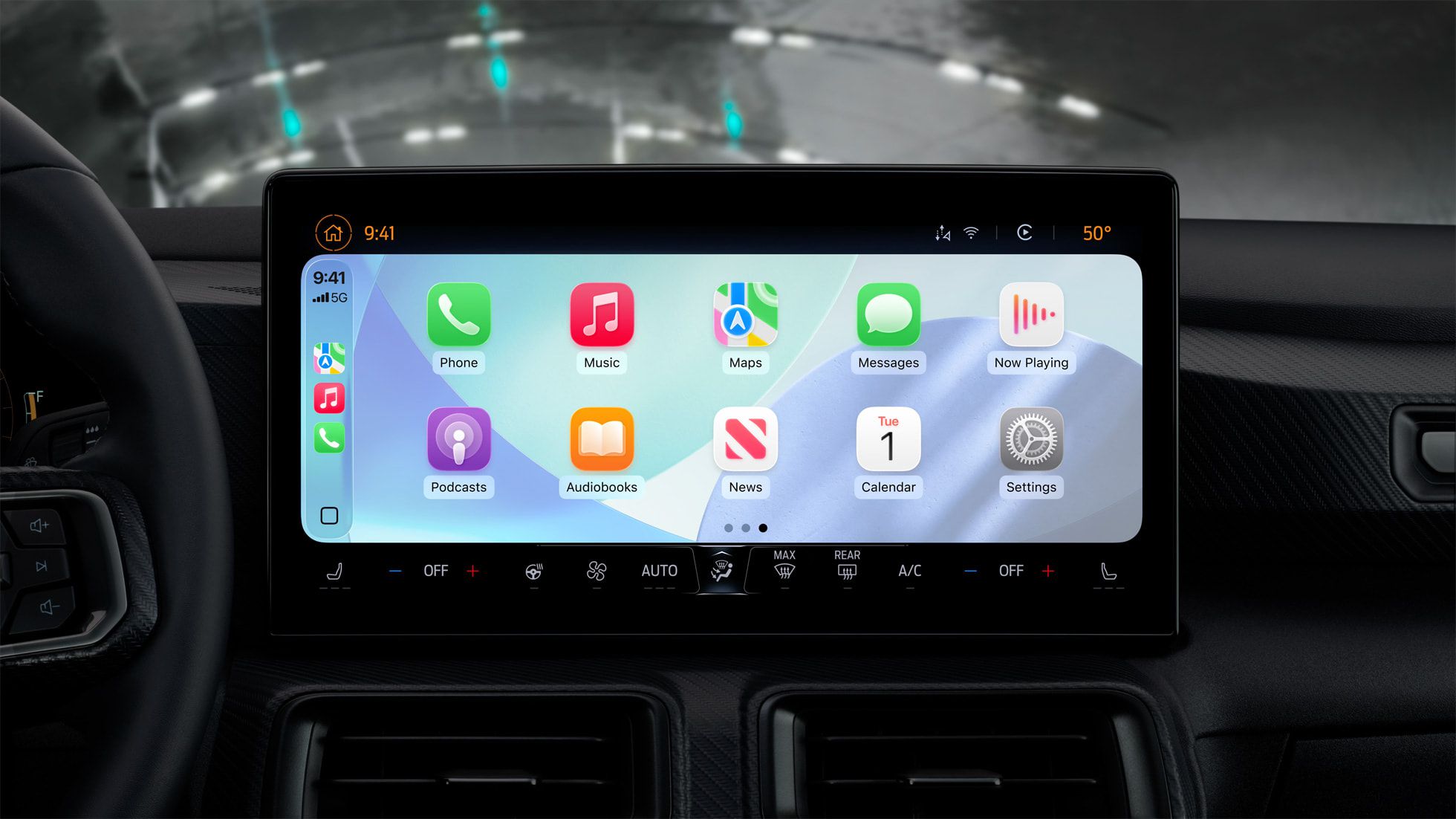
Apple’s relationship with the car has always been pragmatic, even slightly conservative. CarPlay, since its debut, has been an iPhone extension designed to reduce distraction, simplify interaction, and keep Apple’s ecosystem present in a category where product cycles are measured in years, not months. That strategy is about to bend, perhaps dramatically. According to a new report cited by MacRumors, Apple plans to allow third-party chatbot apps to integrate with CarPlay, putting services like ChatGPT, Claude, and Gemini within reach of drivers for the first time. It is not just a feature add. It is an admission that conversational AI is becoming a primary interface, and that the dashboard is the next battleground.
The practical framing matters. The report says these AI apps will be accessible in CarPlay, but they will not replace Siri, they will not be invoked via a wake word, and they will not be permitted to control vehicle or iPhone functions. Users will have to open an app to enter a voice-based chat mode. In classic Apple fashion, that is a compromise between capability and control. Apple wants the value of modern large language model assistants without surrendering the core system privileges that define safety, privacy, and platform integrity. In other words, you might ask an AI to explain something, draft a message, or summarize an idea, but you will not be letting an outside model steer the vehicle’s core behaviors or quietly insinuate itself into the operating system.
Still, even that constrained opening represents a meaningful change in CarPlay’s app economy. Historically, Apple has allowed third-party apps in the car, but only in narrow categories. The point was to keep the interface predictable, auditable, and consistent. A chatbot breaks that mold because it is not a single-purpose utility. It is a general-purpose interface. If Apple truly embraces this model, it invites a new class of in-car experiences that are less like “apps” and more like voice-driven sessions. In a market where consumers increasingly expect their tech to talk back intelligently, Apple is effectively conceding that the in-car question is no longer “which music service do you use” but “which assistant do you trust.”
The timing is not subtle. The report suggests Apple expects to support third-party AI apps in CarPlay “within the coming months,” aligning with the arrival of a smarter Siri in iOS 26.4. That is a crucial contextual clue. Apple is not merely adding AI novelty to CarPlay for entertainment value. It is staging the transition of its own assistant and buying time. The company has been under intensifying pressure as rivals move quickly. Google has had years of experience with Assistant and, more recently, Gemini-branded capabilities across Android surfaces. Tesla has conditioned drivers to expect the car to behave like a constantly evolving software platform. Even the broader consumer market is being trained by ChatGPT itself, which has become a default tool for everything from trivia to planning to writing.
CarPlay sits in a uniquely vulnerable position. Apple does not manufacture the car, and its access is mediated by automakers who increasingly want to own the software layer, the services revenue, and the data. General Motors famously pushed back against CarPlay in certain contexts, and others have signaled a desire to integrate their own systems more deeply. Apple’s counterweight has been user demand, people buy cars expecting CarPlay, and automakers comply. But if CarPlay begins to feel “behind” in the age of AI, that demand could soften, and Apple’s leverage could erode. Opening CarPlay to third-party AI is, in part, a move to ensure CarPlay remains the place where the latest interaction paradigm shows up first.
To understand why this is such a notable moment, it helps to zoom out to Apple’s long-running preference for vertically integrated experiences. Apple historically does not like to put another company’s core product front and center on an Apple surface unless Apple can frame it, constrain it, and monetize it on Apple’s terms. There are exceptions, but they are instructive. Apple allowed Google Maps on iPhone early on because it needed mapping credibility. It later replaced it with Apple Maps once it believed it could own the experience. Apple partnered with Google Search for years because it was economically advantageous and because Apple could present it as a default that still preserved Safari’s role. Apple’s posture with AI assistants has been closer to the Maps playbook, a preference to own the assistant end to end. But the competitive and cultural velocity of generative AI is forcing Apple to behave more like it did in the early iPhone era, when the company prioritized making the platform compelling, even if it meant featuring someone else’s strength.
The report also outlines Apple’s own roadmap in a way that clarifies the strategy. iOS 26.4 is expected to introduce a more personalized Siri that uses large language models, with capabilities like answering more complex questions, completing multi-step tasks, maintaining continuity, and doing more in and between apps. There is also mention of a “World Knowledge Answers” feature that can search the web and summarize information from websites. That is telling. Apple is preparing to shift Siri from a command-and-control tool into something closer to an assistant you can converse with. But the same report suggests Siri’s full chatbot capabilities arrive later, in iOS 27. That gap is where third-party chatbots in CarPlay become especially important. Apple can let advanced assistants handle open-ended questions today, while it continues the longer and harder work of making Siri genuinely competitive without sacrificing Apple’s privacy and on-device principles.
For consumers, this could be the first time CarPlay feels meaningfully “new” in a while, not because the interface looks different, but because the interaction model changes. In the car, the keyboard is hostile and the attention budget is limited. Voice is not optional, it is the only interaction method that scales safely. If third-party assistants are implemented well, they can make the car a place where you can ask for context instead of commands. You are no longer limited to “call this person” or “navigate to that address.” You can ask what that warning light means, how to structure an itinerary, what a phrase in another language translates to, or what a meeting agenda should include. Done responsibly, that is empowering. Done poorly, it is a distraction machine.
That safety question is the elephant in the cabin. Critics will argue that the last thing drivers need is yet another stream of interactive content. They are not wrong to worry. The report indicates Apple will not allow wake-word invocation and will require opening an app to begin chat mode. This friction is intentional. It is a gate, and it signals Apple is thinking like a platform steward rather than an AI maximalist. Apple also appears to be drawing a bright line around system control, keeping third-party assistants from operating the vehicle interface or manipulating iPhone functions in the background. That restraint will frustrate power users, but it will reassure regulators, automakers, and anyone concerned that the dashboard is becoming an ungoverned attention sink.
For developers, the implications are subtler but significant. CarPlay has long been limited in what third-party apps can do. If Apple provides a framework for a “voice-first chat mode” launched within CarPlay, that could standardize how conversational apps behave and what they can present on screen. It also raises strategic questions for AI companies. Will they treat CarPlay as a serious platform with tailored experiences, or as a thin client for their existing iPhone apps? Will they invest in automotive-appropriate interaction patterns, or simply port the core chatbot and call it a day? Apple’s success here will depend not just on enabling these apps, but on enforcing quality and UX constraints, the same kind of discipline that made the App Store viable in the first place.
Competitively, Apple is responding to a market that is rapidly treating AI as a default layer across devices. Google’s ecosystem can weave Gemini into Android Auto experiences in ways that feel native. Tesla’s software approach gives it latitude to integrate AI features deeply, even if those features are not always consistent across regions or versions. Amazon is hungry to place Alexa-like experiences anywhere there is a microphone. Apple’s advantage has historically been trust, privacy framing, and a massive installed base. The risk is perception. If consumers believe Apple is late, the narrative hardens, and Apple ends up fighting both product reality and cultural momentum. Allowing third-party chatbots into CarPlay is a way to short-circuit that narrative, demonstrating that Apple can deliver modern AI utility now, even if its own assistant evolves on a slower, more controlled schedule.
The most interesting question is what this signals about Apple’s future platform posture. If Apple becomes comfortable letting third-party assistants occupy meaningful surfaces like the car, it is not hard to imagine similar openings elsewhere. The company could keep Siri as the default orchestration layer for device control, while allowing users to choose their preferred “brain” for general knowledge and conversation. That would resemble the browser search default model applied to assistants. It is a philosophically different Apple than the one that wanted Siri to be the singular voice of the ecosystem. But it may be the most realistic way to square Apple’s privacy commitments, the demands of users who already live with ChatGPT and Gemini, and the commercial reality that the assistant space is consolidating around a few major model providers.
In the near term, the next few months will matter. Apple needs to show how these chatbots will appear in CarPlay, what restrictions exist, and how it will encourage safe usage. It also needs to ship iOS 26.4 with enough visible Siri progress that the story is not “Apple outsourced the assistant,” but rather “Apple expanded choice while it transitions Siri to a new architecture.” The car is a high-stakes environment, both literally and strategically. If Apple executes well, CarPlay could become one of the most compelling everyday demonstrations of AI done responsibly, voice-first, constrained, and useful. If it stumbles, it will validate critics who believe generative AI is being pushed into contexts where the cost of distraction is too high.
Either way, this is not a minor update. It is a directional change. Apple is opening a door it has historically kept closed, and it is doing so on a surface where Apple cannot afford to lose relevance. The dashboard is becoming a conversational interface. Apple has decided that if Siri is not yet ready to be the whole answer, CarPlay cannot wait.